Book Appointment Now

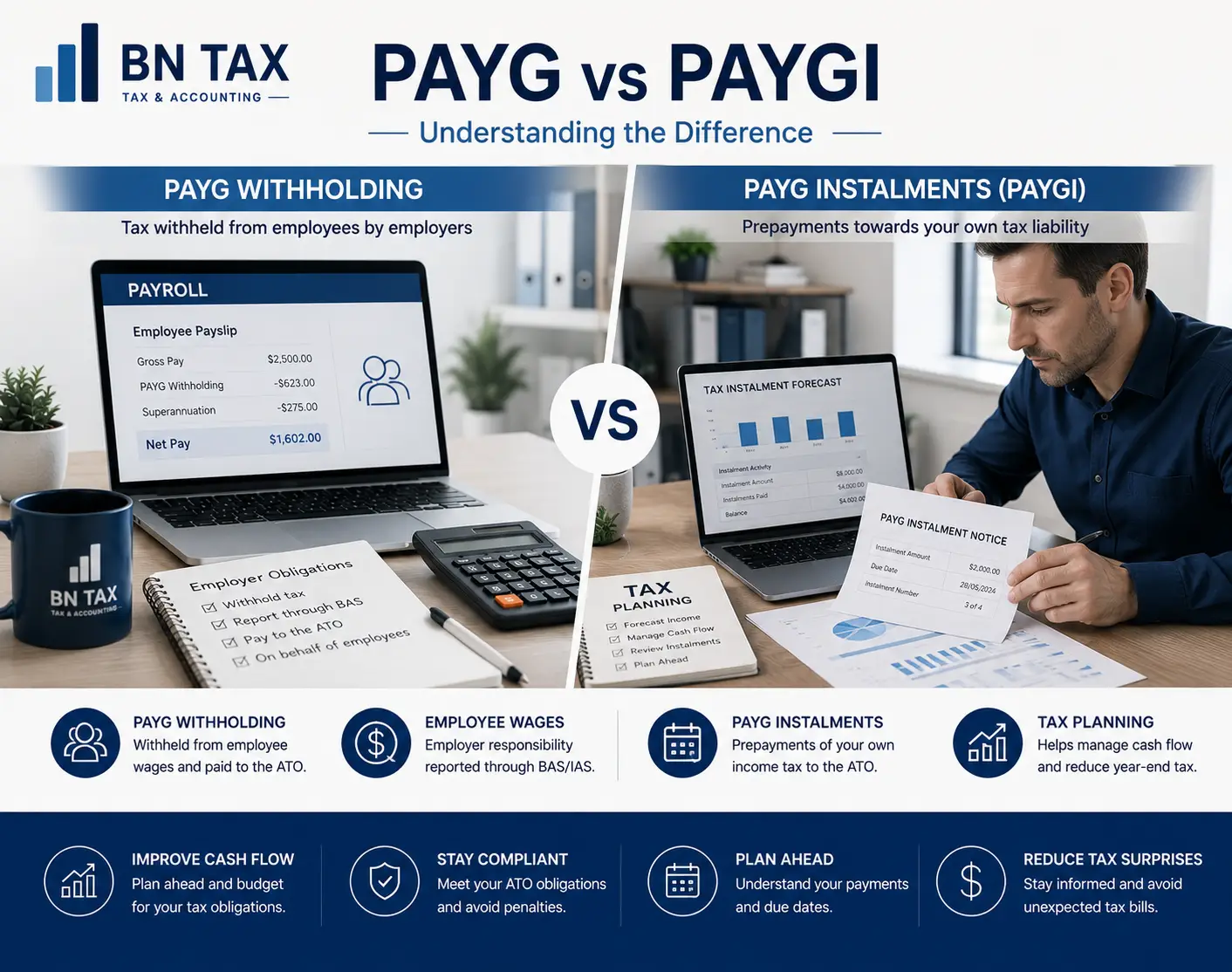
PAYG vs PAYGI: What’s the Difference?
Many Australian business owners receive correspondence from the Australian Taxation Office (ATO) mentioning PAYG instalments (PAYGI) or PAYG withholding and wonder what they mean. While the terms sound similar, they serve very different purposes.
In fact, understanding the difference between PAYG Withholding and PAYG Instalments is essential for staying compliant and managing your business cash flow effectively.
What Is PAYG?
First, PAYG stands for “Pay As You Go” and is the system used by the ATO to collect income tax progressively throughout the year.
However, there are two main PAYG systems that businesses commonly encounter:
- PAYG Withholding
- PAYG Instalments (PAYGI)
Although both involve paying tax during the year, they apply to different situations.
What Is PAYG Withholding?
PAYG Withholding applies when a business employs staff.
Specifically, as an employer, you’re required to withhold a portion of your employees’ wages and send that amount to the ATO on their behalf.
Consequently, this helps employees meet their income tax obligations throughout the year.
Common PAYG Withholding Responsibilities
- Employee wages and salaries
- Directors’ fees
- Some contractor payments
- Bonuses and allowances
- Termination payments
Finally, the withheld amounts are reported and paid through your BAS or IAS lodgements.
What Is PAYG Instalments (PAYGI)?
However, PAYG Instalments are different.
Instead of collecting tax from employees, PAYGI requires businesses and individuals to make regular prepayments towards their own expected income tax liability.
For example, the ATO may place you into the PAYGI system if:
- You operate a profitable business
- You earn investment income
- You receive significant rental income
- You have previously had tax payable
The purpose is to spread tax payments across the year rather than receiving a large tax bill after lodging your tax return.
Key Differences
PAYG Withholding
- Tax withheld from employee wages
- Employer responsibility
- Reported through BAS or IAS
- Paid to the ATO on behalf of employees
PAYG Instalments
- Tax paid towards your own future tax liability
- Business or individual responsibility
- Calculated by the ATO based on previous income
- Helps reduce year-end tax bills
How Are PAYG Instalments Calculated?
In addition, the ATO generally calculates instalments based on your previous tax returns and financial performance.
In some cases, you may be required to:
- Pay a fixed instalment amount, or
- Apply an instalment rate to your business income
However, if your circumstances change significantly, it may be possible to vary your PAYGI amount.
Common PAYG Mistakes
For instance, business owners often:
- Confuse PAYG Withholding and PAYGI
- Fail to set aside funds for PAYGI obligations
- Miss BAS or IAS deadlines
- Incorrectly calculate withholding amounts
- Forgot to review PAYGI variations when income changes
Overall, proper bookkeeping and regular financial reviews can help prevent these issues.
Why PAYG Instalments Matter for Cash Flow
Also, PAYG obligations can have a significant impact on business cash flow.
As a result, understanding upcoming PAYG commitments allows businesses to:
- Budget effectively
- Avoid unexpected tax bills
- Maintain ATO compliance
- Improve financial planning
Therefore, a proactive approach helps reduce stress and creates greater certainty throughout the year.
How BN Tax Can Help
At BN Tax, we assist businesses with PAYG reporting, payroll processing, BAS and IAS lodgements, tax planning, and ongoing compliance support.
Additionally, we help ensure your PAYG obligations are managed correctly while providing advice to improve cash flow and minimise compliance risks.
You can read more in the ATO’s guide to pay as you go instalments on the ATO website.
Need Help Understanding PAYG?
If you’re unsure about PAYG Withholding, PAYG Instalments, or your ATO obligations, contact BN Tax today. Our experienced team can help you stay compliant and keep your business running smoothly.