Book Appointment Now
ATO Updates for Small Business: What’s Changed This Financial Year
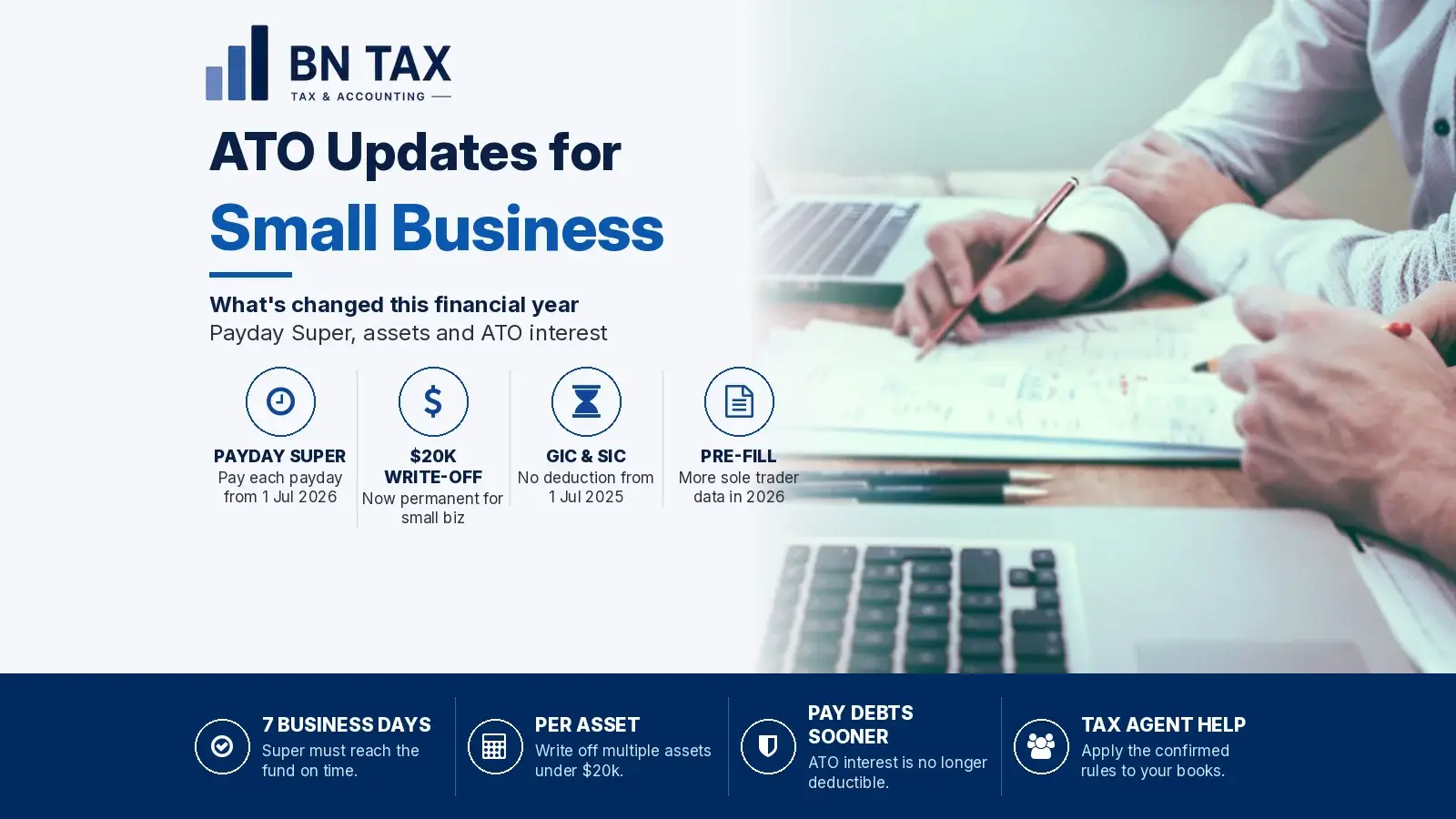
ATO updates for small business this financial year cover Payday Super from 1 July 2026, the permanent $20,000 instant asset write-off, non-deductible ATO interest from 1 July 2025, and expanded sole trader pre-fill.
If you run a cafe, salon, retail shop, consultancy, online store or trade business, pay attention. The ATO updates for small business this financial year are hard to ignore. From 1 July 2026, how you pay super, claim assets and manage ATO interest has changed. Those shifts affect cash flow and compliance.
Below, we summarise the main changes that are already law or confirmed by the ATO. We also flag anything that only applies in certain years. This is general information only, so check the ATO pages linked below for your situation.
Why ATO updates for small business matter now
Many of the biggest shifts started on 1 July 2026, which is the start of the 2026–27 income year. Others began a year earlier and still affect returns you lodge this year.
In short, employers face tighter super deadlines. Small businesses can permanently write off more assets. And interest the ATO charges is no longer tax-deductible. Together, those rules change how you plan payroll, purchases and tax debts.
Payday Super: the biggest change this year
From 1 July 2026, Payday Super is law. According to the ATO, you must pay super guarantee for each payday instead of waiting until the end of the quarter.
Key points from the ATO’s About Payday Super page:
- Super guarantee is still 12%, but it is calculated on qualifying earnings (not only ordinary time earnings).
- Contributions must reach the employee’s super fund within 7 business days after payday (unless a longer timeframe applies, such as for new employees).
- You must report both qualifying earnings and the super liability through Single Touch Payroll (STP).
- The ATO’s Small Business Superannuation Clearing House is closed for payments on or after 1 July 2026.
If a contribution is late or incomplete, the super guarantee charge can apply. The ATO also says late payment offsets are not available under Payday Super.
Therefore, most employers should pay super on payday and fix rejected payments quickly. Cash-flow planning matters more than under the old quarterly cycle. Cafes with casuals, salons with part-timers, and tradies with subcontractors paid mainly for labour all need clean employee and fund data.
Instant asset write-off: $20,000 is now permanent
Good news on the asset side. The ATO confirms the $20,000 instant asset write-off for small businesses is now law and permanent from 1 July 2026.
According to the ATO’s $20,000 Instant Asset Write-off page:
- Eligible businesses need aggregated annual turnover under $10 million.
- You can deduct the business portion of eligible depreciating assets costing less than $20,000 that are first used or installed ready for use in the income year.
- The limit applies per asset, so you can write off more than one asset.
- Assets at $20,000 or more can still go into the small business simplified depreciation pool.
The Government had already extended the $20,000 threshold for 1 July 2025 to 30 June 2026. From 1 July 2026, that higher threshold continues permanently. So if you need tools, equipment or fit-out under $20,000, the timing still matters, but the temporary cliff has been removed.
ATO interest charges are no longer deductible
Another change bites if you carry a tax debt. General interest charge (GIC) and shortfall interest charge (SIC) incurred on or after 1 July 2025 are not income-tax deductible.
The ATO’s denying deductions for ATO interest charges page says this is now law. Interest incurred before 1 July 2025 can still be claimed in the 2024–25 and earlier income years.
In practical terms, unpaid tax costs more after that date because you lose the old deduction. If you owe the ATO, paying down the debt or using a payment plan sooner reduces the interest that compounds daily.
Other ATO updates for small business this year
A few more confirmed measures from the ATO’s what’s new for small business toolkit are worth knowing:
- Sole trader pre-fill (Tax Time 2026): Pre-fill for sole traders now includes more business data, such as assessable payments reported on a Taxable payments annual report (TPAR), your ABN, and opening stock where relevant. You still must review every pre-filled figure before you lodge.
- Longer amendment window: Businesses with aggregated turnover under $50 million now have up to 4 years from the assessment date to request amendments for the 2024–25 and later income years.
- PHEVs and FBT: From 1 April 2025, plug-in hybrid electric vehicles are no longer treated as zero or low emissions vehicles for fringe benefits tax. Providing a PHEV for personal use can create FBT. The ATO also offers a shortcut method for home-charging electricity costs when you meet the eligibility rules.
None of these replace your own records. Pre-fill helps, but incomplete books still create incomplete returns.
What this means for your records and cash flow
Taken together, the ATO updates for small business push you toward cleaner books and tighter cash planning:
- Align payroll and super so contributions leave with each pay run.
- Keep asset invoices ready if you claim the instant write-off.
- Don’t leave ATO debts sitting unpaid while interest compounds without a deduction.
- Review BAS, PAYG and income figures before you rely on pre-fill.
If your bookkeeping is behind, fix that first. Our sister business BN Books can help with bookkeeping and payroll while we handle the tax side. For GST timing, see our guide to how BAS works for Australian businesses. If you are still catching up on last year’s return, our post on the 31 October tax deadline explains the lodgement rules.
We also support small businesses online in areas such as Aspley. See Tax Returns & BAS in Aspley and our Aspley tax checklist for small businesses. For the wider list of places we serve, visit the Areas we service hub.
How BN Tax can help
BN Tax is a registered tax agent with more than 20 years’ experience helping individuals, sole traders and small businesses across Australia. We work 100% remotely, so location is not a barrier.
Need help with these ATO updates for small business? We can walk you through the confirmed rules, lodging, BAS and asset planning, then apply them to your records.
Call us on 1300 790 113, visit our tax returns page, or use our contact page to get started. We know small business!
This article is general information only and doesn’t take your personal circumstances into account. Rules and dates are as published by the ATO at the time of writing (November 2026). Always check the current ATO guidance or speak with a registered tax agent before you act.
Sources: ATO: What’s new for small business · ATO: About Payday Super · ATO: Payday Super is here · ATO: $20,000 Instant Asset Write-off · ATO: Denying deductions for ATO interest charges